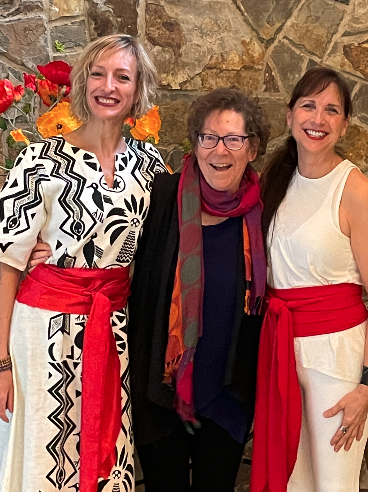
Debbie-Lee, me and Kellie Chambers at my white belt awards ceremony. Photo by Nanou
Day 6 of 52 dance challenge
So, staggering out of bed at 6:30 a.m. to dance Nia before getting ready for camping with friends.
I pulled up an online NIA routine focused on reviewing the 52 moves. I am no stranger to these moves. I’ve been engaged in this practice for five years. I earned my white belt training with the incomparable Debbie-Lee van Ginkel and Kellie Chambers.
But sometimes it’s good to go back to beginner’s mind. Two things that stood out: I’d forgotten how important it is when throwing cross-body punches to keep a stable base and not torque the knees. And I hadn’t ever really understood that on downward blocks, the block stops in front of the groin.
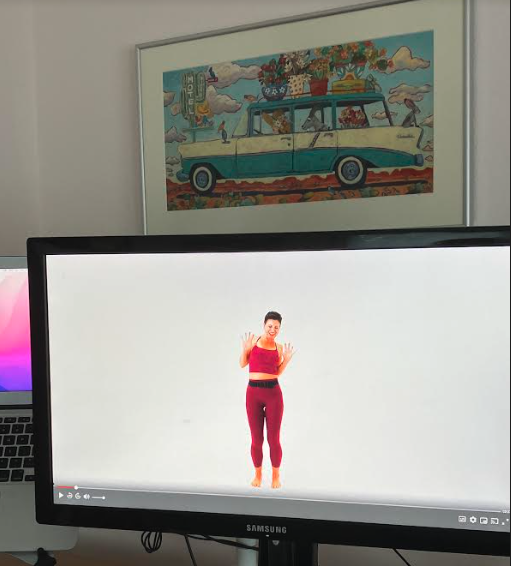
You just never know with Nia. Today, I thought I’d grab 30 minutes of dance using the video routines available at Nia on Demand, since, as far as I know there aren’t any live classes in my area on Saturday.
I queued up Bloom because I’ve danced it several times, and it has two of my favorite songs.
It was my first time dancing Bloom guided by trainer Christina Mae Wolf. Honestly, it was so good, I couldn’t stop at 30 minutes and I did the whole thing.
Here are my three takeaways from dancing this morning with my computer:
Nia routines aren’t just dances strung together, they’re stories and the Bloom story is beautiful. It’s my body living the story as I dance it and hear it.
Nia lets all my selves come out to play. Bloom has me dancing to Katharine Appleton’s “Rebel Soul” (“I can be good if I wanna, I just don’t wanna”) and Velvet Moon’s “Live Your Life” (“Go on now, be good, be fine”). The dance steps move through the sensuous to the dainty to the powerful.
The better I know the routine, the more I can let go of watching the instructor to being in my own body and dancing my dance. That last realization has given me another goal in my 52 days of dancing challenge. I will take time to learn Bloom so that I can dance it myself.
Dancing with teacher Dael Parsons on Friday, reminded me how important NIA is for brain plasticity. We danced Fly, a routine from the NIA archives that includes combinations of foot, hand and arm moves that require some thinking to achieve, a little like rubbing your head while patting your belly and doing the cha cha. Doing it to the rhythm of the music, not crashing into fellow dancers, counting the steps to shift from one set of moves to another, that all gives my brain a workout. The research says that putting demands on both physical and cognitive functions helps build neuroplasticity, which enhances cognitive function, a fancy way of saying your brain can adapt, change and learn.
I love dancing with Dael, who in addition to being a great NIA teacher, also has a deep understanding of the healing arts part of the practice. Most people think of yoga when they talk about healing arts, but NIA also pulls in the Feldenkrais Method and the Alexander Technique. Dael brings those healing arts into consideration when helping her students set their focus and intention. She’ll also dash off a quick word about a book or an idea worth following.
Today, for example, she reminded us that “humans are hard-wired for bliss,” and in case we wanted to dig deeper, mentioned neuroscientist Candace Pert who coined the phrase.