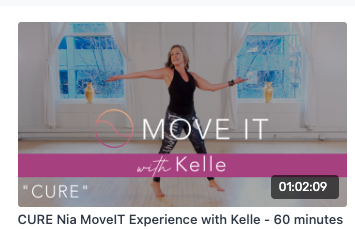
Yesterday’s NIA for me was all about my achy knee. Today I worried that 60 minutes of NIA might be too much for my twitchy joint. Maybe today would be a 10-minute dance day? On the other hand, NIA genius trainer Kellie Chambers’ studio is a 17-minute drive from my house. Plus dancing among NIA pals feels good. I figured if it was too much, I’d just ease up or quit early.
Today was a great reminder that the way I feel one day isn’t necessarily the way I’m going to feel another day. NIA folks say dance your today body. And I did. And I didn’t have to quit early or ease up too much.
In fact, a different amazing thing happened. I felt such a rush of joy from the combination of music and movement, that my heart just welled up with crazy emotion. I mean, I teared up. It’s a thing that defies explanation, this nexus of movement, music and emotion. Maybe there’s research about it.
When I show up for NIA, NIA shows up and uplifts me.
I’m not a big fan of dancing with my computer. NIA has always been about community, sharing joy of dance with others. But I know there will be days when I can’t get to a local class. Since my motivation right now is high, I thought I’d try a full 60-minute online routine.
I’ve tried this before, most notably when I was stuck in a Covid quarantine back in 2020, when I wanted to visit my mom in Canada and the government required a full two weeks of isolation for visitors once they’d arrived. I had lined up a nice little apartment for the quarantine. In two weeks, I danced NIA three times, and only once made it to 30 minutes. I couldn’t feel it. Today, though, I got lucky. I chose a NIA trainer I’ve never danced with before, Kelle Rae Oien and an unfamiliar routine, Cure, which turned out to be the right combination for me to make it all the way through 60 minutes of dancing with my computer.
It was great. NIA instructors all offer encouraging comments during a routine, a word here, a phrase there. It’s like a fingerprint, unique to each of them. Kelle Rae Oien’s NIA chatter kept me going and I particularly liked the “Find the step, then find you in it,” comment. Today I was working with a sore knee and trying not to do anything painful. It’s interesting when you focus on your body this way. Two things I learned: I could do a surprising number of the steps without feeling pain. “A Stance” wasn’t good for me today. But “Open Stance” worked. About 40 minutes in, standing itself wasn’t pain-free, so I sat for about 10 minutes and did the upper body movements. The second thing: I couldn’t always anticipate whether a step or stretch would be painful. Trying first then modifying if needed worked. “Find the step, then find you in it.” Thanks Kelle Rae!
Because it also offers much shorter options, I imagine I’ll also turn to NIA on Demand, when my motivation and enthusiasm for this starts to ebb (somewhere around day 20, I’m guessing.)
My life changed when I embraced the dance practice known as NIA. Recently I wrote a piece about NIA for our local weekly paper. I also then shared on the blog, a more personal story of how it had helped me get control of my relationship with food.
Now I’m giving myself a personal challenge to dance NIA every day for 52 days. I usually make it to three or four hourlong classes each week. But the NIA website also has online routines for subscribers ($16/month) for when local classes and my schedule don’t sync up.
Why 52 days? Well, NIA uses 52 distinct stances and moves in its choreography, so I let that lead me. Why daily? I’ve learned that interesting and unexpected things happen when you commit to a daily practice or routine.
I’m also committing to 52 blog entries because I have learned that pairing writing with an activity strengthens my commitment and focuses my attention.
While I know people who dance a full hourlong NIA routine daily, I’m not committing to that. NIA online has five, 10, and 30-minute routines that I can try out. I don’t care if it’s just five minutes or 60 minutes. It will be daily, starting today when I danced “Fly” with Eugene NIA instructor Dael Parsons. I appreciated Parsons’ reminding us that NIA helps build flexibility, strength, mobility, stability and agility. And it enhances something unexpected: stillness.
More about NIA: Here’s a great summary from Australian NIA instructor Sophie Marsh.