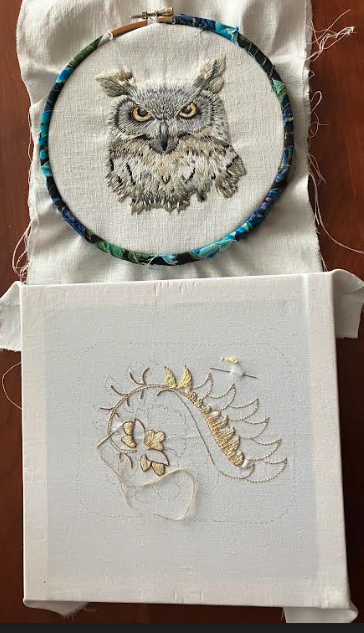
That moment when you decide to try stretcher bars after four years of embroidery using the classic hoop.
Should have migrated years ago. No matter what I did, I couldn’t get the fabric for the owl project, and many others, sufficiently tight in the hoop. For me, the big challenge with thread painting embroidery is keeping the fabric from puckering. That great horned owl design, by the way, is Trish Burr, who’s embroidery has to be seen to be believed.
By contrast for my current project, a sweet little swirly floral thing designed by artist Hazel Blomkamp, the cotton is tacked down on wood stretcher bars as taut as I need.
In yesterday’s blog I mentioned E.M. Forster’s book “Aspects of the Novel.” An early 20th-century novelist, Forster’s book on writing has been on my desk for a couple of decades. It is taken from a series of lectures he gave on the subject and has a fine spoken feel, in addition to being true, and useful. Here’s a sample: Forster discussing story.
Let us listen to three voices. If you ask one type of man, “What does a novel do?” he will reply placidly: “Well—I don’t know—it seems a funny sort of question to ask—a novel’s a novel—well, I don’t know—I suppose it kind of tells a story, so to speak.” He is quite good-tempered and vague, and probably driving a motor-bus at the same time and paying no more attention to literature than it merits. Another man, whom I visualize as on a golf-course, will be aggressive and brisk. He will reply: “What does a novel do? Why, tell a story of course, and I’ve no use for it if it didn’t. I like a story. Very bad taste on my part, no doubt, but I like a story. You can take your art, you can take your literature, you can take your music, but give me a good story. And I like a story to be a story, mind, and my wife’s the same.” And a third man he says in a sort of drooping regretful voice, “Yes—oh, dear, yes—the novel tells a story.” I respect and admire the first speaker. I detest and fear the second. And the third is myself. Yes—oh, dear, yes—the novel tells a story. That is the fundamental aspect without which it could not exist. That is the highest factor common to all novels, and I wish that it was not so, that it could be something different—melody, or perception of the truth, not this low atavistic form.
For the more we look at the story (the story that is a story, mind), the more we disentangle it from the finer growths that it supports, the less shall we find to admire. It runs like a backbone—or may I say a tape-worm, for its beginning and end are arbitrary. It is immensely old—goes back to neolithic times, perhaps to palæolithic. Neanderthal man listened to stories, if one may judge by the shape of his skull. The primitive audience, gaping round the camp-fire, fatigued with contending against the mammoth or the woolly rhinoceros, and only kept awake by suspense. What would happen next? The novelist droned on, and as soon as the audience guessed what happened next, they either fell asleep or killed him. We can estimate the dangers incurred when we think of the career of Scheherazade in somewhat later times. Scheherazade avoided her fate because she knew how to wield the weapon of suspense—the only literary tool that has any effect upon tyrants and savages.
There are many many books about writing. Among my favorites: “Bird by Bird,” written by that expert of the inner landscape Anne LaMott; and “Story,” a book about screenwriting that’s wonderful for any kind of writer, by Robert McKee. But I come back to Forster when I want a sympathetic colleague standing over my shoulder offering humor with a bit of backbone that often gets me back on track.
Don’t know if it’s the February sky — low and drizzly — but Bob Dylan’s“Oh Mercy” (1989) and “Love and Theft” (2001) drew me in recently. I’m struck by how precise and yet how loosey- goosey Dylan’s lyrics feel.
“What Good am I?” from “Oh Mercy” captures in such simple language and tones how I feel sometimes when I consider my place in my home and my community and the world.
“What good am I if I know and don’t do, If I see and don’t say, if I look right through you, If I turn a deaf ear to the thunderin’ sky, What good am I?”
Contemplative. Gently pointed.
From “Mississippi” on “Love and Theft” there’s this oddly longing yet upbeat feel. The lines that linger for me:
“Well my ship’s been split to splinters and it’s sinking fast I’m drownin’ in the poison, got no future, got no past But my heart is not weary, it’s light and it’s free I’ve got nothin’ but affection for all those who’ve sailed with me”
Also from “Love and Theft,” I’m just grooving on the easy rhythm of “Moonlight,” that feels like a sweet tribute to ’40s-era jazzy pop. Dylan seems to have chosen words for how well their syllables sync with the rhythm.
“The boulevards of cypress trees The masquerades of birds and bees The petals, pink and white, the wind has blown Won’t you meet me out in the moonlight alone?”
As I listen and think about the way songwriters use language, I appreciate how writing is both mysterious and contrived, structural and free.
I think that’s why writers must give free rein to the spin of uncontrolled imaginings and then pull those reins to bring shape and narrative form in the service story. For free expression, the poets/songwriters may be the best teachers. For narrative structure, I love E.M. Forster’s “Aspects of the Novel.”