• Clyde Tombaugh was a Kansas farm boy in the 1920s who couldn’t afford college so he just did what he could on the farm in his spare time: Built his own telescopes and took meticulous notes about his night-sky observations. He sent his notes to the Lowell Observatory in Flagstaff AZ when he heard they were hiring and his notes got him a job. The Lowell Observatory is a private institution founded in 1894 by Percival Lowell, son of wealthy Massachusetts industrialists and educators. Lowell was convinced another planet beyond Neptune influenced its orbit and Tombaugh, using the 24-inch Clark refracting telescope (pictured above) found Pluto in 1930. It turned out that Lowell was wrong about Pluto’s influence on Neptune. Eventually Pluto was reclassified as a dwarf planet in Kuiper belt. But the Clark telescope is still a remarkable instrument, still functional and available for viewing the night sky by the likes of you and me. Lowell invites folks up to the observatory on clear nights to get a closeup view of stars, nebula, galaxies. At our visit there this month, Craig and I saw the Orion Nebula using the 126-year-old Clark telescope. We also got introduced to the stunning Cigar Galaxy. Exciting research continues at Lowell. This is why we travel.
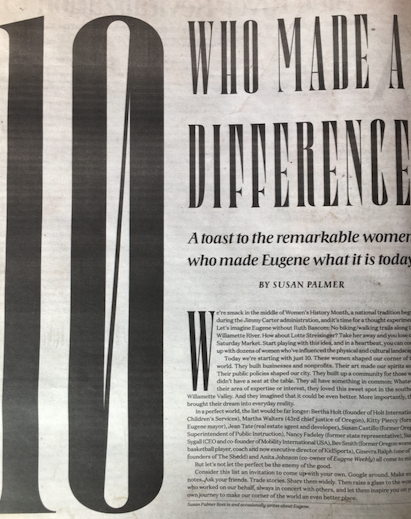
  • A salute to those who make writers’ words come alive on paper. I’ve had the great privilege of working with award-winning page designers at various newspapers over the years, and they can make or break a reader’s first impression. My most recent project, a tribute to local women, has two completely different looks. The photo at left shows the printed page. The one below shows the electronic edition. Two completely different fonts and layouts. This is talented Todd Cooper’s work. I am delighted with both efforts. I bring this up because I know many writers these days self publish and I would advise not skimping on layout. Good page designers are worth the investment.

  • Sometimes our local weekly newspaper lets me knock out a piece for them. My latest, brief profiles of the local women who made a difference in Eugene, Oregon, was a delight to research.

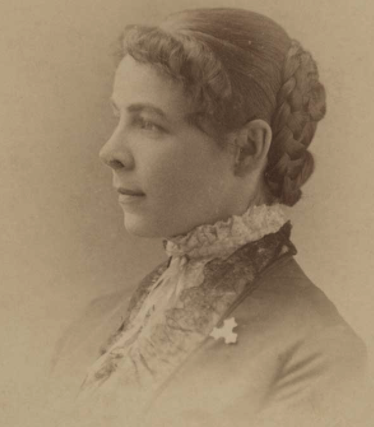
    While all of the women I wrote about are inspiring, I’m deeply intrigued by Alice Hall Chapman. She was a physician and wife of the second president of the University of Oregon. I was unable to unearth much about her, but I will continue plugging away. I lost her trail in the 1930s. She would have been in her 60s by then. She was living in a Pasadena, CA, boarding house at that point, according to census records. I feel confident it’s her because how many Alice Hall Chapmans were physicians back then? (And how cool is it that census records noted professions.) Can’t find her in the census records after that, but I’ll be scoping out some of the online family history sites that our public library permits free access to.

    I would love any advice from family history sleuths. I’d like to know when and where she died and was buried. I’d like to know if any universities besides the UO preserved her papers. I’d like to find articles published about her in local papers. Etc.