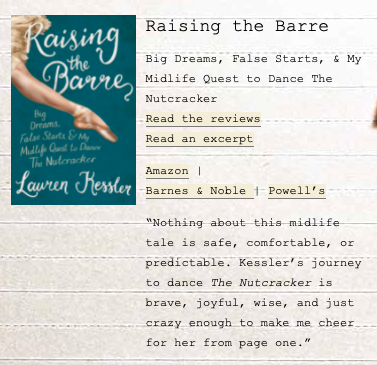
I don’t know why I’ve taken a few years to get around to Lauren Kessler’s excellent book about tackling one of the toughest forms of dance at a time in life when most of us are preferring to sit longer in comfy chairs. But I’ve become enamored with dance myself in the last two years, albeit a much easier kind of dance in the form of Nia. And then last summer I got entirely sucked into an additional more aerobic dance class that kicks my ass but has me smiling the whole damn time. So now it seems I’m at dance class three or four times a week, and maybe that’s why “Raising the Barre” caught my attention.
It’s a fine book about taking risks, facing fears, learning to be in your body when you’re mostly a person who has lived in your head. Also it confirmed my horror of mirrors. But the reason I’m making note of it is for Kessler’s writing chops. I respect the voice in this book, but I realize I also respect the mind behind the voice when she describes a ballet instructor’s efforts to get his students to understand what he wants them to do. Here’s an excerpt:
“Imagine a string attached to the top of your head,” he says, pulling at this imaginary cord at the top of his own head. His voice is soft, and there’s a hint of singsong to it. “You are being pulled upward even as you plie down. It’s hard to describe,” he says, silent again for just a tick longer than you would expect from a teacher giving instructions. “It’s this thing about gravity,” he says, smiling to himself and swaying a bit. “You need to learn to feel it differently.” … As I struggle with the movement and watch him struggling for the right words, it occurs to me what’s happening. Antonio’s first language is not English. It’s not because he was born elsewhere (he is from Hawaii, which, last I heard, was part of the United States) and English is literally his second language. It’s because he’s a dancer and dance is his first language. His body speaks it fluently. It takes extra effort to translate the language of the body into words. The effort, the silence, is him feeling his wordless first language and then searching for words to express what his body knows.”
I don’t know whether this notion came to Kessler in a flash of insight or whether she struggled over this section of writing and gritted her way to this astonishingly fine description. Either way, it was the moment in the book when I realized I was in the hands not only of a good writer and but also a fine intellect.

 Susan Palmer's Exquisite Now