• Dusk on Steens Mountain — Susan Palmer

    The first time I heard a Nia dance trainer say, “Smell the moment,” my internal rant persona engaged: You can’t smell a moment. You can smell a flower or a turd. A moment? Ridiculous.

    But patience (not my top virtue nor even a middle virtue, more a fleeting one) sometimes brings me around. Now I understand that it’s just another way of inviting someone to take a deep breath in. So why not just say: “Take a deep breath in.”

    I’m just guessing here, but having followed the instruction (with grumbling of course, grumbling being my resting state), there’s some kind of extra thing that happens. Adding a sensory directive puts me both in the moment and in my body. This is good for someone who spends way to much time stuck in my head.

    Breathing deeply is healthy. Deep breaths are more efficient: they allow your body to fully exchange incoming oxygen with outgoing carbon dioxide. They have also been shown to slow the heartbeat, lower or stabilize blood pressure and lower stress., says Dr. James Hoyt, a pulmonologist at UCHealth Pulmonology Clinic.

    So, I offer this picture from a recent camping trip in southern Oregon. Take a deep breath in and imagine that ineffable aroma of downed leaves in mid-autumn. I know sitting here in my studio, I’m doing just that, settled and ready for a writing day.
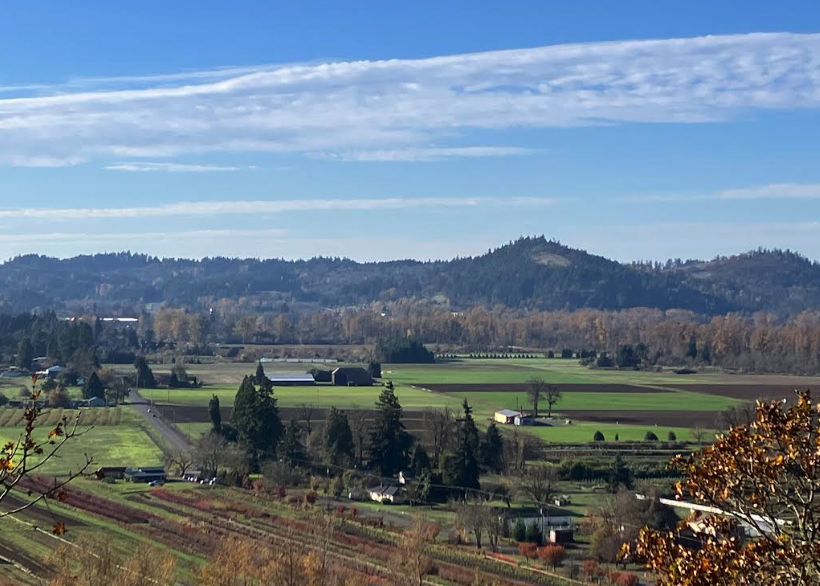
  • This is such a sweet view of the southern Willamette Valley, and just a 20-minute drive and 10-minute walk to get there, there being a hiking trail that winds to the top of Mount Pisgah (actually more of a hill). Going to the top reveals the sweep of the Cascade Mountains, but I’m partial lately to the farmland that hugs the Coast Fork of the Willamette River on the edge of our fair city.

    Six days ago we were at the Oregon coast, and took a brief hike through rainforest on a misty morning. It’s mushroom season here, the mycellium sending up these strange and wonderful fruiting bodies. All our mushroom hunting pals are out gathering chanterelles. We’re just enjoying the view.

    The health sites all note the benefits of being out in nature, both physical and psychological. They even have a term for it — ecopsychology — in addition to a recommended dosage: 120 minutes outdoors in nature-made spaces a week. There’s plenty of wild right in our neighborhood, but we also don’t have to go far to get fully immersed.

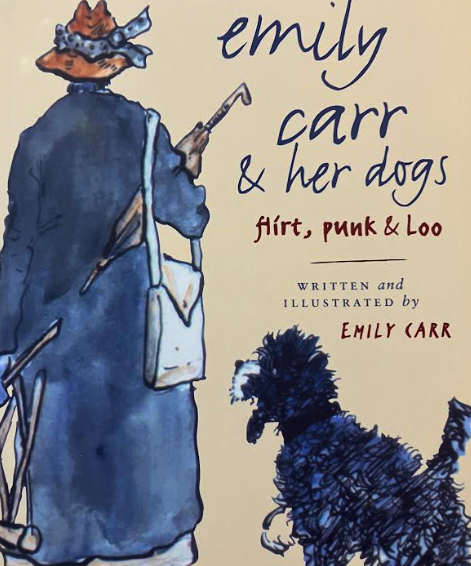
  • Canadian artist Emily Carr, with whom I’m recently smitten, wasn’t necessarily appreciated in her home town, Victoria British Columbia. She was part of a Canadian artistic vanguard in the early 20th century, embracing modernism and moving away from strictly representational art. They loved her work in Toronto. Her neighbors often scratched their heads. She expressed her frustration over this in a journal entry, part of a collection from her journals published under the title “Hundred and Thousands,” which I am really enjoying.

    Here’s what she wrote after acquaintances stopped by her studio in 1934.

    They all stood at the end of the room like a lot of cornered rats, pop-eyed and shocked at the sketches. Nobody knew what to say so there was that awful silence in which one tosses sketch after sketch on the easel hooks with nervous haste and wants to sink through the floor. Then someone breaks the silence with a horrid “What’s that supposed to be?” and somebody else says, “Do explain them to us,” and someone else gasps, “Just where is that?” and you want to slap all their faces, burn up all your stuff and then dig a deep hole, tumble into it and claw the earth over yourself.

    I wish I could go back in time and reassure her that people would come to gasp at the immense beauty of her vision, that the Art Canada Institute would describe her as one of the first artists of national significance to emerge from the West Coast, that she was a leading figure in Canadian modern art. But those moments of uncertainty, did not appear to redirect her. She kept working on the vision she held.

    Also worth noting from that journal entry is the paragraph that followed the above, concerning the swirling global uncertainties of the time:

    Horrid things are in the paper today. Austria up to ructions. Somebody assassinated. Europe trembling and everyone saying, “What’s coming?” God alone knows. Gee whiz, I’m tired, mentally and physically.