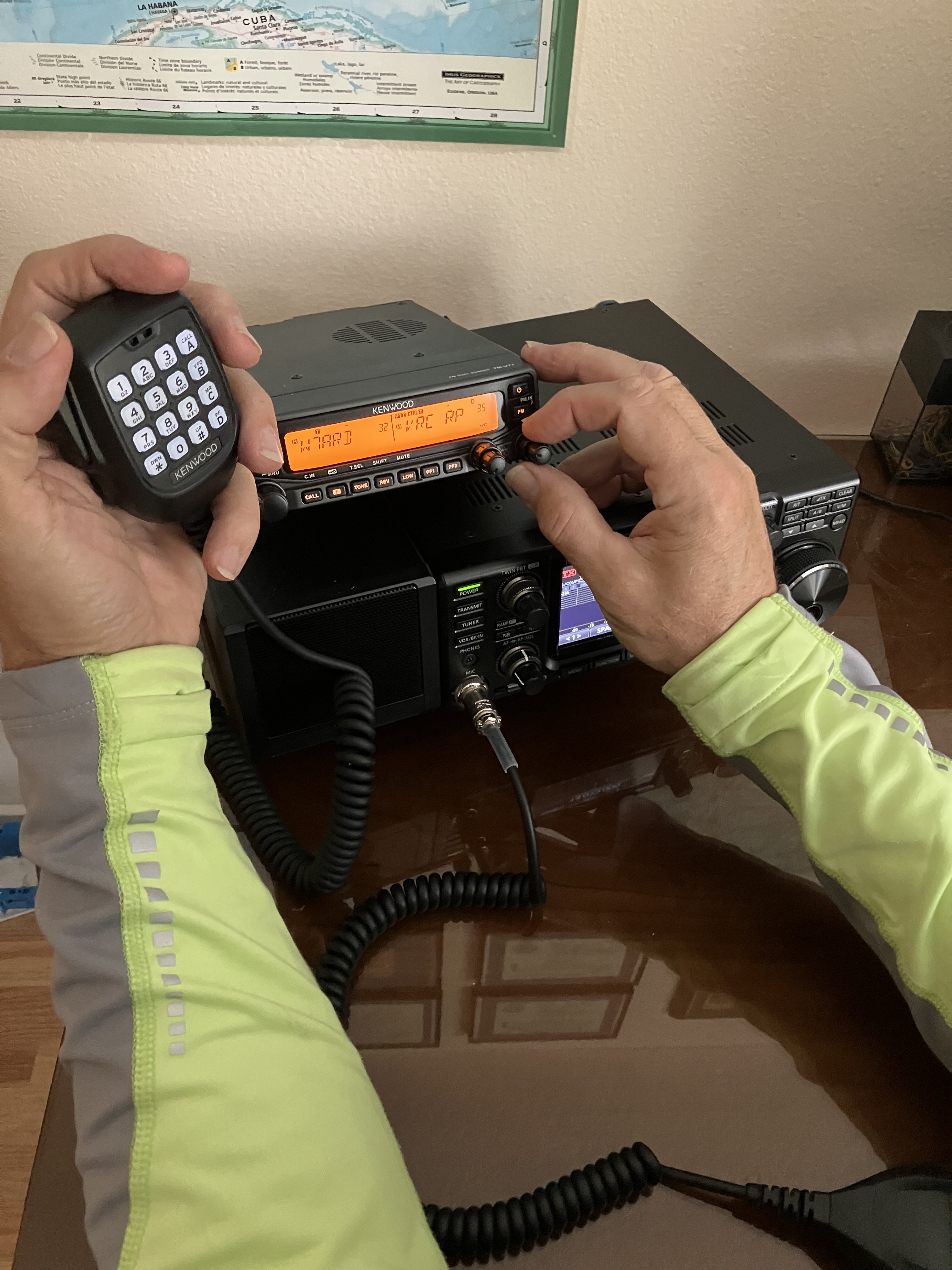
Amateur radio, AKA ham radio, never caught my interest. People fussing with complicated gadgets, raising odd antennas on the roof — someone in Antarctica talking to someone in Alaska — I mean, get a cell phone for heck’s sake.
It might as well be magic for all I understood it.
But I have this amazing partner, Craig Cherry, who likes tinkering with gadgets and who is involved in our neighborhood’s emergency preparedness group. Ham radio, it turns out, is integral to that effort. Last winter he suggested that I get my ham radio license, a process that requires some study and taking a test to show you know your amperes from your ohms and your farads from your henrys.
I dismissed the idea right out of the gate. I couldn’t even tell the difference between watts and volts. And up until a few months ago, I did not care. When Craig asked a second and then a third time, I saw that it was important to him, and since he has been known to visit Canada in the freaking winter with me just because I ask, well, quid pro quo. Also: We live on a river held back by 13 aging earthen dams, the next subduction zone earthquake and accompanying tsunami are overdue, and wildfires have ramped up in recent years. Semper paratus as the Coast Guard says.
So I said, OK.
Then I began reading the study guide. It kicked me back to junior high school days when I was wrapping my head around algebra, the first stumbling block being that letters had, through some strange metaphysical process, become stand-ins for numbers. Frankly, it pissed me off. Learning that doesn’t emerge from one’s own native curiosity and that requires time and effort to absorb, that’s hard.
Learning about electricity, radio frequencies, bandwidths, transmitting, receiving, amateur radio etiquette, FCC regulations, has brought the adolescent me back in spades. I get cranky. I storm around and yell. Then Craig explains a thing. Then I settle down and read some more and another little piece of knowledge embeds in my brain.
One slow step at a time, I am making progress. I do know the difference between current, volts and watts. I do know that farads are a unit of measure of capacitance and that henrys are a unit of measure of inductance and that capacitors and inductors store energy differently. I know enough to pass practice tests about half the time. That is 100 percent more than I knew last April.
Science fiction author Arthur C. Clarke noted once that any sufficiently advanced technology is indistinguishable from magic.
Perhaps I will end the year viewing radio as technology, something in my wheelhouse.


 Susan Palmer's Exquisite Now