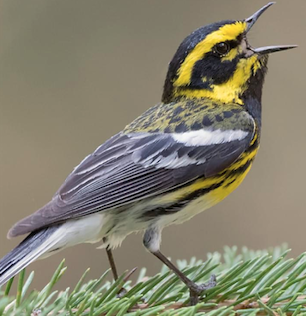
• Last week, a Townsend’s warbler showed up at our backyard bird feeder. The picture of this little guy comes from the All About Bird’s website, Cornell University’s ornithology lab, which is an excellent site for birding info.

    The Townsend’s warbler is a West Coast species, a bird about the size of a chickadee, and it only partakes of our feeder in late winter/early spring. This bird prefers the high canopy of fir forests, and drops down to city yards when the forest pickings are slim, or it’s migrating from warmer southern forests. I think we get them because we live in a neighborhood of mature evergreens, including cedars and firs and even a couple of towering sequoias.

    I’m more dilettante than devoted birder, but I know this little guy because its distinctive yellow is so much brighter than that of goldfinches, the other yellow birds common at our feeder.

    Any activity that requires close observation (Is that a varied thrush or a robin, a rough-legged hawk or an osprey?) benefits writers. Verisimilitude often lives in the small details. My hand-embroidery practice also enhances observation skills. Replicating the colors of nature with thread requires me to spend a lot of time on the tiniest details.

    Observation isn’t limited to the visual channel. Last week Craig and I spent several days in Astoria. At an overlook above the mouth of the mighty Columbia River, on a rain-smeared afternoon, we sat gawking at the gray churning water and the distant forested slopes on the Washington side of the river. Then I heard the unmistakable sound of eagles. American movie makers don’t really like the chittering high-pitched call of actual eagles, so they often substitute the cry of some other hawks, the red-tailed hawk, for example, but I’ve learned to tell the difference.

    I didn’t know we’d see eagles this particular day, but I’d brought my spotting scope and two of the three eagles circling and calling settled at the top of a Douglas fir tree for more than an hour. We got a good long look at them. What surprised me was how long the two eagles spent facing each other, just inches apart, without really moving. I wondered if we were seeing mating behavior.
  • Real-world making brings some kind of benefit to a writer. Using actual materials with actual tools provides a different creative boost. So I tell myself. Maybe it’s just writing avoidance.

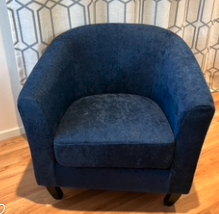
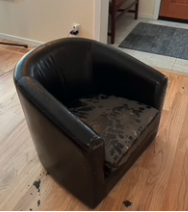
    Anyway. The barrel chair. When I bought it more than a decade ago, I thought it was a leather chair. But it was something they call bonded leather, a product that has the same relationship to leather that medium-density fiber board has to solid wood. It failed quickly, which was a shame because it’s one of my favorite chairs.

    I have no experience with upholstery. On the other hand, I’ve worked through the making stages with other projects and thought I had most of the skills to pull it off.

    Previous projects: I designed and constructed bug netting for the van windows, a hand-sewn quilt that took almost a year to complete, and an intricate embroidery work that included challenging stitching, then mounting and framing the work. With no looming deadline, these projects were more like play.

    Bonded leather fails in a particular peeling fashion. No way to fix it. I used my seam ripper to remove it from the chair which under the fake outer material looked well-constructed (solid wood, in other words). I detached all the pieces that had been sewn together so I’d have templates to use to cut my new fabric, a sturdy polyester-acrylic blend. I sacrificed an old loose-weave cotton drop-cloth to do a practice run so as not to waste expensive fabric on the learning curve.

    I laid out the bonded leather pieces on the cotton, cut them out and then sewed them together and fitted them over the chair to ensure the strategy would work.

    It did so I repeated the effort with the expensive fabric.

    The internet — with all its great how-to videos — made my effort seem reasonably achievable and convinced me I’d need an upholstery stapler to succeed. A DIY upholsterer helped me figure out which pneumatic stapler would be best for me. And the manufacturer I chose had some great how-to videos showing how to use the stapler on real-world projects. (I only injured myself slightly learning how not to injure myself.)

    Here’s the newly covered chair. Perfectly good though not entirely perfect.

    Perhaps real-world work buttresses imaginative work. Or maybe just taking a break from being in my head is its chief value.

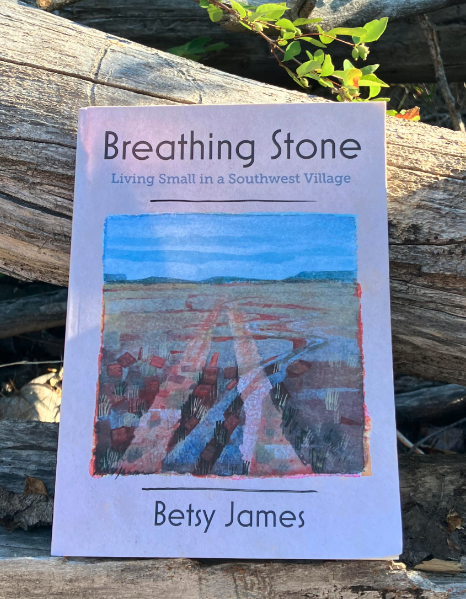
  • I took Betsy James’ new memoir with me on a road trip to the Canadian Rockies and found it a fine antidote to hours of driving. The world rushing by at 70 mph, the shift from rolling canola fields to jagged upthrust peaks, the rumbling trains, the smoke from fires — my mind getting edgy and tight.

    And then comes a quiet evening in a remote camp and time to open a book. “Breathing Stone” isn’t in a rush. It’s in a place. James unfolds the place in language that is, on some pages, serene and beckoning, on others rough and wild.

    After months of being swept up in mysteries and thrillers, racing through narratives that are all about what happens next, I find it pleasing to be in a book about what happens now and always.

    An excerpt won’t really capture this. I think one need all the words in their delicate and particular order. I am reminded a little of Edward Abbey’s “Desert Solitaire”, another book that offers the gift of place to a reader.

    It’s like being brought back to one’s self.