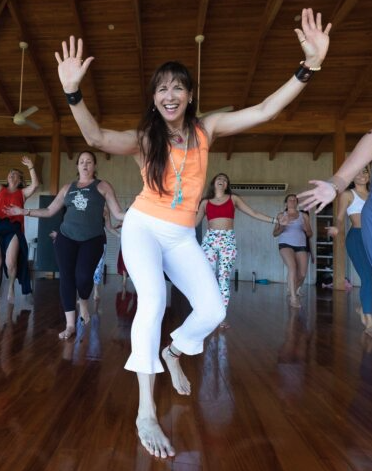
• NIA dance teacher Kellie Chambers

    I’ve been dancing NIA for five years. I recently wrote a piece for our local weekly newspaper that explains NIA, but since that story wasn’t about me, I didn’t describe my personal experience with it.

    Aside from the sheer love of moving to music, which I think all of us have (whether it’s foot tapping or wild leaping) NIA has helped me love my body. That happened over time and with the encouragement of NIA teachers to trust my myself. “Your body, your way,” is a NIA mantra.

    This mantra has filtered into other areas of my life. I will share just one of many examples. Roughly a year and a half ago, I was unhappy with my weight. I tipped the scales at 167 pounds. I’ve never been thin, but this was a lot for a 5’2″ woman to be packing around. I’m old enough to have seen many diet fads come and go. Some helped me knock a few pounds off, but nothing stuck. I always gained the weight back. This isn’t an unusual story and researchers who specialize in weight loss confirm that keeping off lost pounds is something just 20 percent of dieters do.

    Because I’d just spent a few years in weekly NIA classes absorbing the “my body, my way” message, I began thinking about what would work for me. I didn’t look outside myself for a weight loss strategy. And I came up with a focus and intent (another NIA thing) about eating. I began thinking of myself as someone who has a food allergy — say a nut allergy or lactose intolerance. I told myself that I would need to manage my eating differently for the rest of my life. To lose weight, I’d have to eat less. I wouldn’t eliminate any food categories, I’d just eat less.

    That was the beginning of incremental changes that allowed me to shed 17 pounds in 10 months. I’ve been able to keep those pounds from coming back over the last six months. I am not for a minute saying that the weight loss has been easy. I’ve kept a journal about it, and there are entries in my journal where the word “brutal” gets used. It has been psychologically brutal to step on the scales and see no change when I think I’ve been a responsible eater. But progress has come in my body’s time and way, and the success is sweet. I own it. And the success helps propels me forward.

    For me, NIA has been more than an exercise I do a few times a week (once a week when I’m really busy, four times a week when my schedule allows). It has changed the way I think about my body. And that change has altered the ways that I think about a lot of other things.

    The act of dancing NIA, of moving to wonderful music with a community of dancers, brings great joy in the moment. If that’s all it did, it would be more than worth it. I’m so glad I found it.


  • …or why we went to Philadelphia. The United States offers plenty of opportunities to see big boats masquerading as museums and I have been to a few of them. Most recently, the light ship Columbia, a floating lighthouse that helped ships find their way to the mouth of the Columbia River from 1951 to 1979. Also, in Norfolk VA, the battleship USS Wisconsin. Even the WWII-era German U-boat, captured by the US Navy in 1944 and currently on display at the Chicago Museum of Science and Industry

    But I’d never seen a ship in dry dock until the USS New Jersey (same class battleship as the Wisconsin) went into dry dock for some repair work and painting this spring. Usually the New Jersey is available for tours at its pier in Camden NJ, but the most suitable dry dock (built back in the 1920s and still functioning) is in the Navy Ship Yard in Philadelphia. Tours of the ship exterior in dry dock, seemed like a once in a lifetime experience. So we went.

    Dry docks work like locks. The ship pulls in. Supporting blocks get placed under her (inspected by divers to ensure proper location) The water gets drained out, held out by a caisson that holds back — in this case — the Delaware River. Workers will be repairing and painting the 887-foot ship for most of May.

    Imagining the various complex systems that keep a ship afloat and functioning, even as a museum, to say nothing of being a fully functioning war vessel is kind of hard to get my head around. The New Jersey first launched on Dec. 7, 1942 and served in the Pacific during World War II. Decommissioned for the final time in 1991, she had served through the Korean and Vietnam wars and did duty in the Mediterranean during the Persian Gulf War. Additional photos for scale:

    Note the guys near lower red-painted hull section for scale.

  • Lately I’ve been looking for additional strategies to help me achieve my goals. Over the past 18 months I’ve made two changes, shedding one bad habit and embracing one good habit, thanks in part to author Katy Milkman, who wrote “How to Change.”

    What I’ve learned over the past 18 months is that being consistent in maintaining good habits and keeping from reverting to bad ones is a daily kind of business. I have to keep lifting those weights to maintain those muscles, literally and figuratively. And while the suite of strategies in Milkman’s book are good, sometimes I want a bright new thing to try to keep me headed in the direction my best self wants to go.

    So I’ve been browsing through other books about change. I’m struck by how many of them promise easy or simple techniques. That has not been my experience at all. A technique may be simple or easy to describe. Actually deploying it, that’s a whole other thing.

    To adapt a great line from the film “The Princess Bride:” Change is hard. Anyone who says differently is selling something.

    Here are three things I learned from Katy Milkman’s book that have helped me to maintain changes and pursue goals:

    • Pairing. Combine a pleasant thing with a less-pleasant one. I used this strategy to help myself study for my ham radio license. I’d place a light tea light below a small bowl of water with an aromatic oil, like rose or lavender, a pleasing ritual to get me started studying something that came hard for me.
    • Recording progress. I have a “got done” calendar, a daily record of the number of words written, miles walked, dance classes attended, my weight — whatever I want to keep track of. Tracking, especially my weight, helps me be aware of the impact of my choices. Those calendars are also hugely reassuring when I forget how much I have done to meet goals.
    • Understanding my personal barriers to change. It varies, depending on the goal. I have enough experience now with this purposeful effort to change to know that I can often overcome my own inertia. One of my favorite strategies is taken from AA. I don’t have to refrain from (fill in the blank) forever. Just for today.

    I don’t have boatloads of willpower, but I have some. And because of Milkman’s book, I have strategies. I don’t think she says anywhere in her work that change is easy. But she does offer hope that it is doable.