Today, election day, Nia instructor Dael Parsons chose the “Joy” routine for us to dance. She said it’s the first time in her memory that a political campaign centered its messaging on joy.
Of course, politicians and political parties don’t own emotions; our bodies do. Still it’s a fine thing to be reminded to consider joy in the collaborative work of participatory democracy.
I dance with people of all political persuasions and I love that we come together, moving in our own ways yet finding common ground in the rhythm of the music.
I expect the coming days will bring many emotions, and I dream that regardless of winners and losers, we all find a way to respect and uplift the best in all of us.
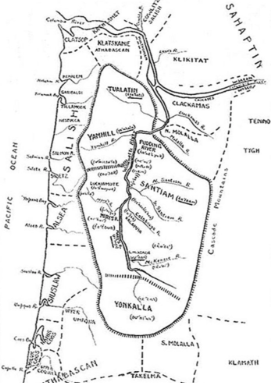
“The Kalapuya Communities” map, c. 1850. Center for Columbia River History
I want to spend some time this month considering the people who called the Willamette Valley home for thousands of years. Congress and then-president George Bush in 1990 set aside November to recognize the contributions of Native Americans, and I appreciate that effort as a reminder for me to learn more.
Here in Oregon the Kalapuya have been recognized for uniquely melding both coastal and plateau cultures, according to an overview by the Oregon Historical Society. The society’s articles are worth reading:
In a nutshell: Two deadly epidemics decimated the Kalapuya before white settlers arrived, reducing a population of around 20,000 to fewer than 500 (note that sources vary on these numbers). Treaties and broken promises, removal onto reservations, the loss of official tribal status all tell a familiar chilling tale. But the Kalapuya — along with dozens of other Pacific Northwest nations — persevered.
Among my favorite sources for learning about Oregon’s indigenous cultures is the website of Oregon State University professor David G. Lewis, whose Quartux Journal, has a wealth of information.
I particularly appreciate the brief history specifically focused on the Kalapuya.
Another good website for learning (from a full North American perspective) is Wisdom of the Elders, which preserves and shares cultural history, arts, language and ecological knowledge, seeking to enhance cultural sustainability, multimedia education, and cultural reconciliation.
I loved seeing one of our local Kalapuya leaders, Esther Stutzman highlighted on that web site, where she tells the wonderful creation story of Le-lu, First Woman.
It’s yet another thing to be grateful for this month.
Yesterday, after posting about sitting less, I went to Dael Parson’s Nia class — we danced Deep Dive — one of my favorites. When I got home I had a note from instructor Val Wetmore, inviting me to join her afternoon class at the local Y. So I did! Very energizing. (A fine thing about retirement: veering off the day’s plan because I can.)
This morning I tried the new routine just posted online. Amethyst with Laurie Bass: 30 minutes focused on core movements for conditioning the spine. A thing I’ve struggled to do in Nia, thanks to wrist and hand issues, is bring my hands together in the prayer position. Today I managed it just fine. I can’t remember when I noticed that I can do this position without discomfort. I think it’s been a slow and somewhat seamless process of improvement. My body my way.

 Susan Palmer's Exquisite Now