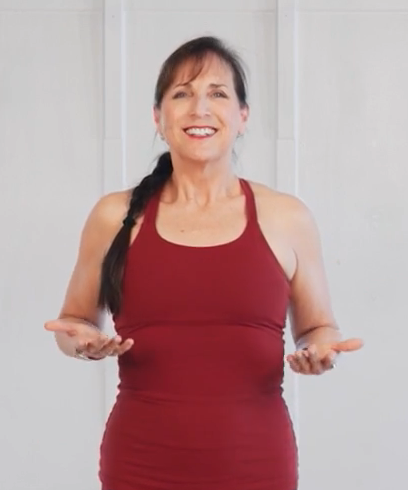
There’s something about the routine “Alchemy,” that satisfies. Dancing it this morning before a busy feast day gets underway, I was struck by its combination of powerful and yet deeply feminine moves.
I’ve written so much about the feelings that come up for me while dancing. Today, especially toward the end during the steps to “A Mi Madre” by Caro Luna, there was a deep sense of contentment. I’m grateful for Nia. Every day.
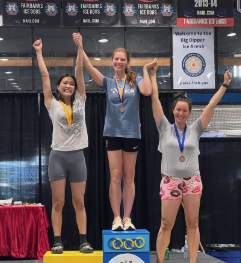
Celebrating Emily King, who last summer broke a world record set in 1989 in the one-foot high kick at the World Eskimo-Indian Olympics last July. What she did is kind of stunning: Standing on one foot, she leaps up and kicks a sealskin ball with that same foot then lands on that same foot. The ball she kicked to set the record was 85 inches off the ground. That’s 7 feet high. Here’s a link to the video. The woman King hugs at the end is the woman who set the 1989 record. https://www.facebook.com/reel/1987916265017979
King is Tahltan, a tribe of the Stikine River area of northern British Columbia. She won four gold medals in last summer’s event, according to the Yukon News.
It’s been so exhilarating to look for news items regarding Native Americans this November, which is Native American Heritage Month. Since I’ve been search for interesting information and then blogging about it, the Internet has noticed and now my Facebook feed populates with lots of interesting news and videos, which is how I stumbled on King.
To learn more about the World Eskimo-Indian Olympics:
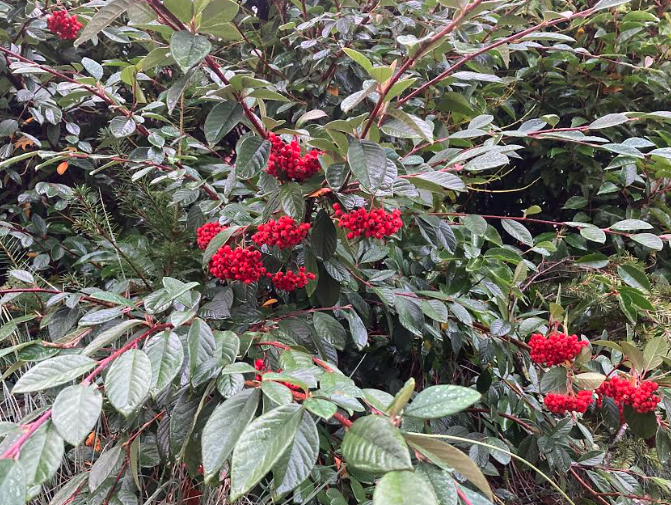
On our morning walk, Craig and I passed this cotoneaster, its red berries the brightest thing around on an otherwise rainy low-cloud-ceiling day. It buoyed my spirits which had been busy with gloom-of-winter thoughts.
I noticed this emotional divergence — gloom vs. pleasure — having just listened to a “Hidden Brain” podcast about emotional resilience that uses biological diversity’s positive impact on ecological resilience as a mental health model.
HIdden brain host Shankar Vidantam interviews researcher and psychologist Jordi Quoidbach who suggests that allowing ourselves to experience a diversity of emotions, both positive and negative, builds emotional resilience.
The hourlong podcast has so much going on it’s worth a listen, but the final metaphor nicely sums up the research. Here’s the exchange between host and guest.
VEDANTAM: I’m thinking about this idea from Buddhism, which is that when an emotion appears in our hearts, we should almost treat it like a guest who’s appearing at our house. And according to this idea, you know, when anger shows up at your house, instead of closing the door to anger and saying, I don’t want you, go away, you actually open the door to your anger and invite the anger in as you would invite in an honored guest. And you would sit the guest down, and you would tell the guest, you know, good to see you, thank you for visiting my home. Tell me what you have in mind, what do you have to share? And in some ways, that metaphor of thinking about our emotions as honored guests, I feel meshes really well with the idea that you are talking about here, which is in some ways being curious about the emotions that visit us, not just simply being reactive to them, but being curious about them, allows us to understand what the emotions are actually trying to tell us.
QUOIDBACH: I love that idea, Shankar. And I will add that, you know, not only you treat a guest right … but also a guest is not a permanent resident. You know that the guest at some point will leave. And so you listen to the guest, but at the end of the day, you choose how you want to react, rather than according to the emotion, too much weight.
VEDANTAM: … because I feel like the two things we often end up doing when negative emotions appear is we either try and shut the door to the negative emotion and say, don’t enter my house, or we open the door and allow the emotion in some ways to sweep us off and assume that the guest now owns the house and runs our life. And in some ways, you’re saying that both of those in some ways are maladaptive.
QUOIDBACH: Absolutely, and if we push the analogy a bit further, the more guests you have at the party, the less attention you’re going to pay to one individual guest. You’re taking care of everyone, and it’s great, and you’re having lots of interesting ideas from everyone. But the more guests you have at your party, the less likely they are to take over.
Since it always comes back to Nia with me, I like how dancing allows many kinds of feelings to flow, and how awareness of the feelings and their transitory nature seems to have enhanced my overall resilience.
 Susan Palmer's Exquisite Now