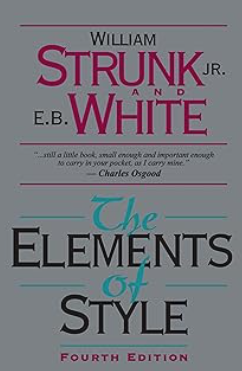
• cover of a book on writing well
    A well-known guide to concise writing.

    I’ve had a manuscript sitting in a folder for a while, a long while. Sometimes a writer knows a problem exists in the story, but can’t quite identify it. Every now and then I’d get the manuscript out and dip into various chapters seeking clues. Then one day last summer, it came to me. I’d written the novel in the first person. This was the problem. So I revised the first three chapters into the third person. Then set it aside for a while. Came back to it. Re-read the revised pages and got pretty excited.

    It all just felt better. Because I have other writing projects going on, I haven’t until this brand new year, worked much on the somewhat tedious rewrite. Now that I am, one of my writer’s ticks has become way too visible to me. I am in love with gerunds.

    Think of gerunds as verbs masquerading as nouns. For example: Revising a manuscript can be tedious. Revise — that’s a verb. You add “ing” to the end, stick it in the position of the subject or object of a sentence and voila! Noun.

    This isn’t a bad thing all by itself. But it gets old fast. I think sometimes I back into ideas as I write and the gerund helps push me forward. It’s fun to take some time with them in this revision, take a second look at the broader paragraph or page and get rid of the ones that weaken rather than serve the prose.

    I wonder. Will telling myself that revising is fun make it so?

    The image above is the cover of what used to be considered one of the best books on good concise writing, “The Elements of Style.” I hear it has fallen out of favor, but I still poke my head in it now and then when my own work gets sloppy.
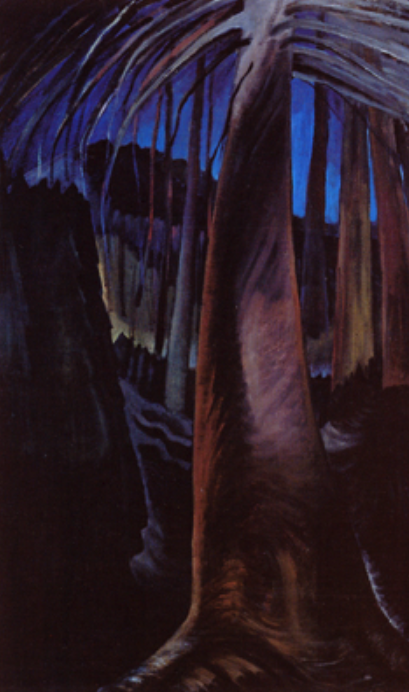
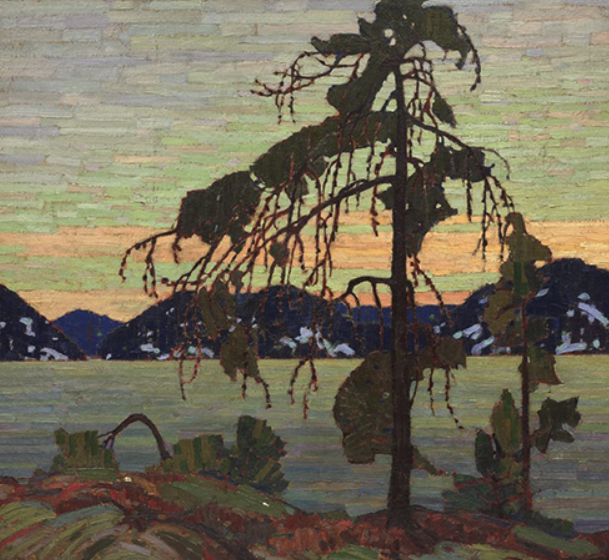
  • I think of the Canadian artists known as the Group of Seven in the same way I think of the Hudson River School, the artists who romanticized the stunning iconic landscapes of the United States in the 19th Century. Think Albert Bierstadt and Thomas Cole.

    Old Trees at Dusk by Canadian artist Emily Carr

    The Group of Seven were also landscape painters, but working in the early 20th-century. They sought to create a distinct artistry, a Canadian ethos — not European, not American — whose allegiance belonged to the vast forests, rugged mountains, rolling prairies, muscular waterways and ocean borders that comprise Canada.

    A gang of Toronto-based artists, they were, at least to my reading, insular and kind of snobby. But their work is amazing. Victoria B.C.-based artist Emily Carr painted the piece I’m showing here. She was never formally included in the Group of Seven, but she should have been. Despite losing her parents when she was a teen-ager, she found a way to study art in San Francisco, London and Paris, before returning to Victoria and bringing her skills to bear on the Pacific Northwest. Her brief biography (linked above) is worth a read.

    I’m enjoying getting to know more about these artists. The image below, Jack Pine by artist Tom Thomson (whose work inspired the Group of Seven), is among the Canadian masterpieces and on display at the National Gallery of Canada, makes me want to go visit that museum and immerse myself in Canadian art. The way he captures the color of winter sky, is profoundly northern to me. There is no light quite like the sun on the low horizon at midday in the northern latitudes.

    The Jack Pine by Tom Thomson

    I’m taking the time to write about this because there’s a lot of Canada talk these days, and I thought it worth sharing something that might be new information for many Americans. Also, something entirely nonpolitical, non-hockey, non-beer, and non-maple-syrup Canadian. So next time someone wants to talk Canada with you, you’ll have another cool thing to share.

    Enjoy!

  • Nobody likes to be told “no.” It’s a full stop. It’s forbidden territory. It blocks momentum. Ever since I was a toddler, I have rebelled against it.

    On the other hand, sometimes getting to “yes,” means wandering through a universe of “no.”

    I let my weight creep up over November and December. Since it took me a good 10 months to lose 20 pounds and since I followed that up with another year of keeping the weight off, which is a whole other challenge, I wanted to get rid of it. I thought embracing dry January would bring things back under control. I was wrong. My “today” body looks pretty much like my “six-weeks-ago” body.

    And so I ask myself, “Do you want to lose those 5 pounds you found last year? And how about losing another 5 while you are at it?” And my answer is an absolute resounding “Yes!”

    But to get there, I must pass through a lengthy “no” gantlet. I must walk through the valley of the shadow of “no.”

    OK, enough with the metaphors.

    I thought about this while dancing Nia today when instructor Kellie Chambers suggested thinking about what the body needs as we danced “Medicine Woman.”

    My past weight loss experience has taught me that I need a certain structure to get through the thicket of food temptations. I know in advance of going to a restaurant that I will limit my menu review to the things I can say yes to — soups, salads, small portions, etc. I know that every day I will urgently want “something” at 3 p.m. that will be easily accessible like a hunk of cheese or a handful of nuts. But I can divert from those high-fat options if I have ready-to-eat veggies in the fridge. I know that if my body signals “hunger,” I need to answer with a healthy-food yes pretty quickly. If I don’t, those pesky brain chemical take over and there’s no negotiating or redirecting that can be done.

    Sometimes I can skip lightly over the “no” by pointing myself, with great joy, past the pleasure of taste sensations toward the pleasure of success in sticking to my plan.

    Mostly I try to live in my today body. But I know from dance practice that dancing today serves to maintain the strength, flexibility and agility of my tomorrow body. Saying “no” to cake today is saying “yes” to health right now and also tomorrow. Less stress on my joints, less work for my heart, etc.

    So here on the front end of February 2025, I’m inviting my mind to help me ponder all the ways that saying “no” to certain foods is fully signifying “yes” in a longer-time-frame context.

    Yet another gift of Nia.