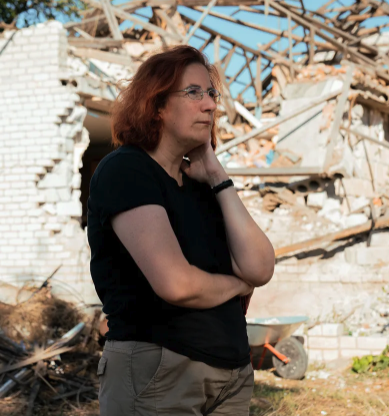
Anna Bowles, a British writer, does volunteer work in Ukraine and writes about it. I subscribe to her blog because her work touches my heart.
She’s a poet as well as an essayist and offered some of her recent published poetry in a blog titled Weapons Grade Poetry. My only words about her words are those of gratitude. Also, that poetry strips what doesn’t matter away. All signal. No noise. The poems offer a different kind of window into war.
I’m deeply moved, especially by this poem. I’ve been reading Bowles for a while but Grandmother Rising prompted me to pony up for a paid subscription.
Regardless of whether people favor or abhor the current actions of the Trump administration, three facts are undeniable.
The Trump administration is usurping the power of the purse, which the U.S. Constitution gave to Congress. The administration cannot legally end funding to agencies and programs already funded by Congress.
The Trump administration is ignoring regulations that govern how agency administrators can be fired.
The Trump administration is threatening to ignore the rulings of federal judges.
While these facts, reported by universally respected news outlets, might lead to results that please some people (shuttering various agencies, gutting regulations that feel constraining to corporations), the broader outcome should worry all Americans.
If this president can flout the Constitution, can all future presidents flout the Constitution? If this president can ignore the rulings of the courts, can all future presidents do so? That’s the broader outcome.
The United States is a concept, an idea about how all of us can live together in some kind of rowdy, argumentative but ultimately reasonable way. It is only an idea. The minute the wealthiest and most powerful among us decide that they don’t have to live within the guidelines first agreed upon 236 years ago by 13 newly formed states, that idea disappears in a puff of smoke and U.S. democracy is dead.
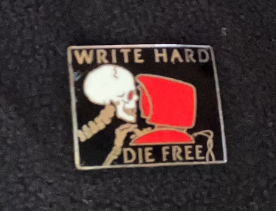
A little over three decades ago, a genius editor at the Anchorage Daily News (winner of two Pulitzer Prizes) gave those of us working in the newsroom these great pins, riffing on a line from the Hell’s Angels biker gang.
Write Hard, Die Free.
I’m wearing my pin in solidarity with the journalists currently under attack by this administration. I’m wearing my pin in solidarity with attorneys and judges upholding the U.S. Constitution in the face on unprecedented threats. I’m wearing my pin in solidarity with the activists standing in public places calling for all of us, regardless of our political persuasions, to uphold the principles that have held this nation together, mostly, since 1789.
As a retired journalist, I have a very small platform with my blog. But I will write hard and die free in support of the U.S. Constitution, U.S. democracy, a true north strong and free Canada, and a stubborn belief that all of us ordinary people are better together than the oligarchs who take our labor at a discount in order to amass more of everything for themselves.
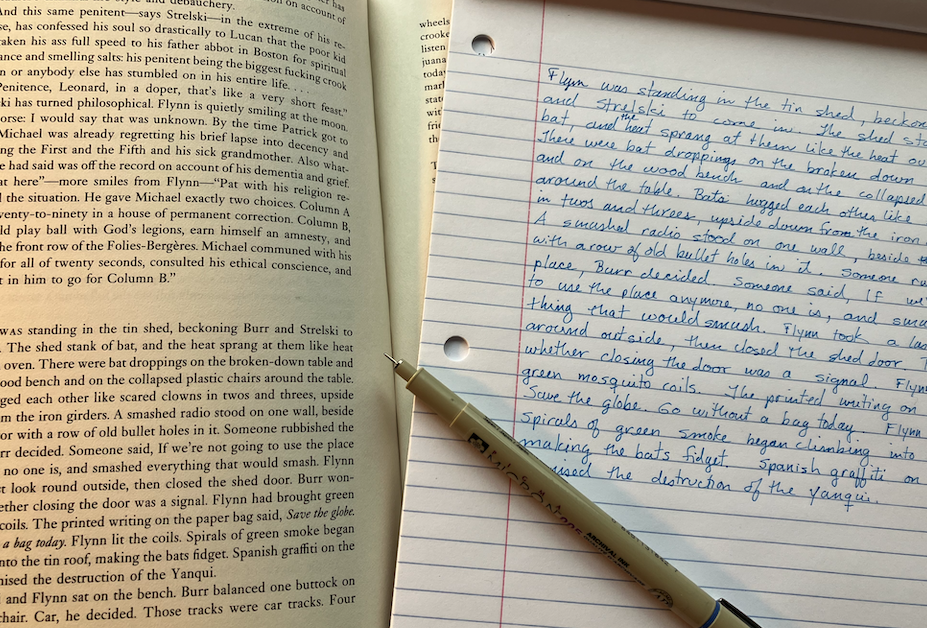
Lately in my social media feed various groups have been promoting the value of copy work, the practice of writing by hand the work of authors that writers admire. The strategy helps us see more deeply into the nuts and bolts of good writing.
I tried this with a favorite book, The Night Manager, by John LeCarre.
I opened a page at random and picked a random paragraph. At first glance, this isn’t a particularly important paragraph. Conspirators are waiting for their first meeting with a double agent. The meeting occurs in an abandoned shed in a third-world country. Here it is:
Flynn was standing in the tin shed, beckoning Burr and Strelski to come in. The shed stank of bat, and the heat sprang at them like heat out of an oven. There were bat droppings on the broken-down table and on the wood bench and on the collapsed plastic chairs around the table. Bats hugged each other like scared clowns in two and threes, upside down on the iron girders. A smashed radio stood on one wall, beside a generator with a row of old bullet holes in it. Someone rubbished the place, Burr decided. Someone said, If we’re not going to use the place anymore, no one is, and smashed everything that would smash. Flynn took a last look round outside, then closed the shed door. Burr wondered whether closing the door was a signal. Flynn had brought green mosquito coils. The printed writing on the paper bag said, Save the globe. Go without a bag today. Flynn lit the coils. Spirals of green smoke began climbing into the tin roof, making the bats fidget. Spanish graffiti on the walls promised the destruction of the Yanqui.
Here’s what writing it out long-hand told me: Everything matters to this master spy novelist. Everything is worth taking time over. In this paragraph, he wants me to feel the slow-down of the pace. I’m waiting, like the characters are waiting for the arrival of the pivotal character who will allow the good guys an interior view of the ways the hugely evil bad guys operate.
Lesser writers do this by having characters standing around smoking cigarettes, gazing out through curtains of rain, sitting with an unread magazine by a dirty cafe window, etc. All fiction writers heighten suspense by slowing the pace toward meaningful action.
But LeCarre is next level. Bats? Smashed radio? Shot-up generator? Mosquito coils? Grocery bag? I feel the heat and smell the stench and see the degradation in that tin shed.
Copying this helped me realize that nothing is throw-away to LeCarre. Everything matters. It’s the be-here-now of writing. Which, I think, is the point of copy work, being with the writer word by word.

 Susan Palmer's Exquisite Now