
• Editing guru Callie Stoker

    Pondering two and a half days at the Pikes Peak Writers Conference, I’m appreciating how the inner scaffolding of a story impacts the enjoyment and resonance for readers.

    Perhaps it came home to me most in Callie Stoker’s presentation titled “Allegory in Your Subtext.”

    She chose the film “Jurassic Park” to illustrate what she means by allegory with an eye to showing what it can do. What’s the film about when examined through the allegory lens? It’s about preparing for parenthood, Stoker said. She went on to show how Dr. Adam Grant’s thoughts about children and behavior toward them evolve through the film. I didn’t know this but there are many discussions about this aspect of the film to be found online.

    That example and others have me examining my own work through the allegory lens, both work that I consider finished and projects that are in process.

    Stoker, who’s CEO of an editing service company titled The Manuscript Doctor, offered three workshops, all of them full of ideas for how I can think more deeply about the connective tissue in my stories.
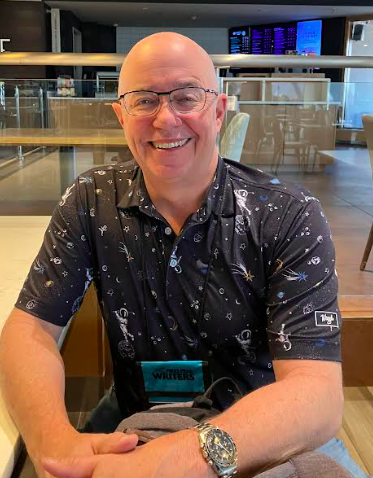
  • Author Kevin Ikenberry. Honestly, don’t you want to take a class from him?

    The chance to learn techniques from established authors is definitely worth the price of admission to Pikes Peak Writers Conference. Yesterday, science fiction author Kevin Ikenberry delivered a great lecture on the care and feeding of antagonists in the novel.

    Ikenberry was personable, funny and informative. He offered great examples to illustrate his points, delving into both literature and film.

    I love that he started out with this great quote from Clive Barker: “I firmly believe a story is only as good as the villain.” Not a surprising statement from the great Barker.

    I’ve written a few villains but they have always been a tool for me, a way of forcing growth and change on my protagonist. Ikenberry said that villains are the heroes of their own story and I hadn’t ever considered that aspect of my various evil doers. So I’m excited to go back to the various things I’m working on with that idea in mind.

    Also, as I think about my antagonists, I’m pleased to realize that one of them, at least, I have given great thought to, and that particular character is among the strongest of my bad guys. I am guessing that on the flight home, I will cue up my other antagonists and start thinking about them more deeply.

    Another point he made that seems self-evident once you think of it, but really caught me by surprise. Sometimes, the adversary is nature, relentless, an entity that can’t be bargained with. I’m throwing that into my hip pocket for future use.

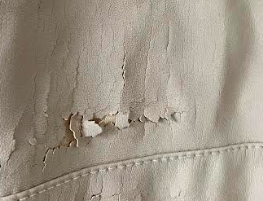
  • Here’s the side of my formerly spiffy fake leather jacket, which I used to wear for work all the time, when I was getting paid to work. That’s, oh, six years back. Yesterday I dug it out of the back of my closet, where it had been undisturbed for six years. I tried it on, and it still fit. Looked pretty good. I figured I would wear it on the flight to Colorado for the writers conference so it wouldn’t get crushed in my suitcase.

    Funny thing about fake leather. It ages badly. Everything was OK until I started to move, and by move I mean walking, pulling my suitcase, sitting down on the plane. Such wildness caused the fake leather to begin slowly shredding. I didn’t notice at first because really, who stops to check whether their clothes are falling apart? But when the plane landed and I stood up, there was this mess of tiny bits of something on my seat. At first I thought it was crumbs, and I guess I was right, but not the edible kind. I looked down at my sleeves and they were splitting and pealing.

    I don’t even know what kind of mess I left in the taxi.

    Fortunately, I brought backup clothing just in case of a wardrobe issue. But I was expecting something along the lines of a wine mishap.

    Don’t buy fake leather. Really. Just don’t. Trust me on this.