The Heceta Head lighthouse is one of 11 on the Oregon coast. Most still functioning as navigation aids. Heceta has a Fresnel lens, an amazing bit of glass magic invented by French physicist Augustin-Jean Fresnel and in use around the world since the 1820s, about 200 years ago. There’s no knowing how many lives his invention saved. The one at Heceta Head was installed in 1894.
It was a pleasure to walk up to it from Heceta beach on a rare sunny day in November.
It still casts the strongest light seen from the Oregon coast and visible 20 nautical miles out to sea. All respect to Fresnel; he suffered from tuberculosis and died at 39.
In an effort to making the coming dreary rainy months more tolerable, I’m employing a strategy I learned from behavioral economist Katy Milkman, whose book “How to Change” has many strategies that I’ve come to value. One of them is pairing, combining an enjoyable thing with a less enjoyable one (listening to energizing rock’n’roll while vacuuming or weeding, for example).
I enjoy hand embroidery, but I decided last spring I wouldn’t embroider during the good weather, and would only break out my projects once the rains started. We’ve had a couple of atmospheric rivers in the last two weeks so I’ve got my projects out. The first one, pictured here, is a belted kingfisher. I based my design on a photo shared on Facebook by a great local photographer, Norman Goo. I did a previous version on scrap cloth to get the thread colors right and am now working it up on a good piece of linen. I drew the guidelines on the fabric in pencil.
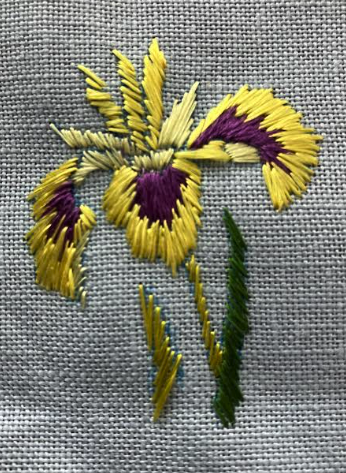
I’ve had this project in the back of my mind for several months so it is highly satisfying to get it out to work on again. Once that’s done, I’ll work on an osprey, also inspired by a Goo photo. And I’ve just purchased my first batch of Piper silk threads, which are so so so different from the usual DMC embroidery floss I use. Embroidery artist Helen Stevens‘ amazing work inspired me to give the silk thread a try and it’s been a bit of a challenge handling them. My test run of these threads had me all thumbs. They are so fine, three stands together equal the size of one strand of DMC floss. Below is my first practice exercise — based on a design I purchased from Stevens’ web site.
I wonder. Will my goal to complete three projects make me wish for a longer winter?
Do not try to do extraordinary things, but do ordinary things with intensity. From Canadian artist and author Emily Carr’s journal, Nov. 16, 1931.
I’ve written about her previously: here and here. Excerpts from her extensive journals have been collected and published, the book titled “Hundreds and Thousands.”



 Susan Palmer's Exquisite Now