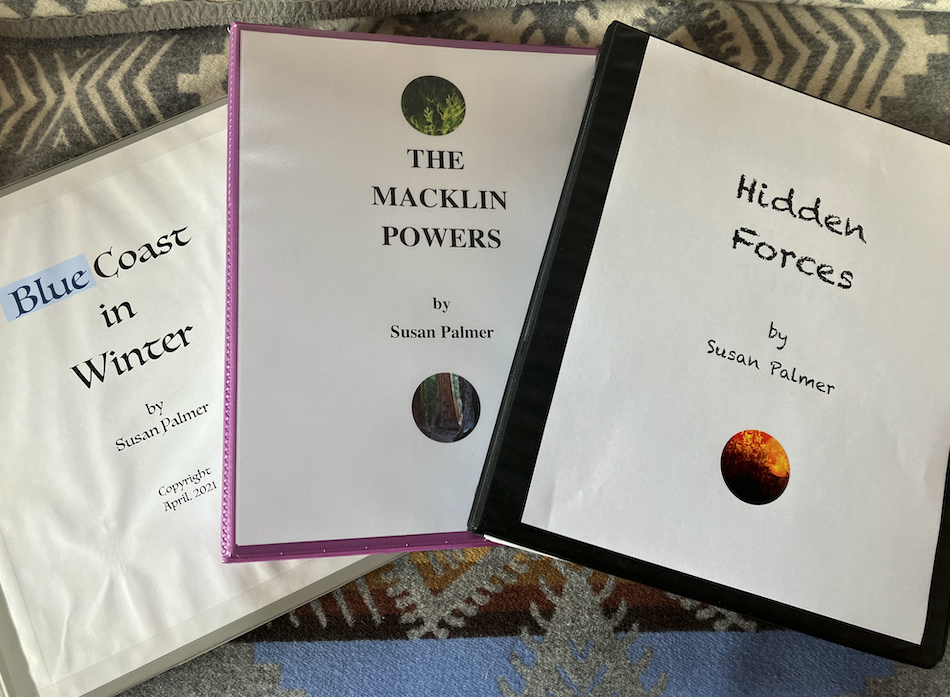
Here’s a waypoint on three writing projects, with some to-do notes. Sharing these interim steps keeps me from falling into negative thinking about what I’m getting done in any given week. I’m juggling three novels in various stages of completion. My work week will involve all three.
The Macklin Powers: completed, copy editing done, query letter and synopsis written, comparable novels identified, agents to submit to identified, first three submissions sent. Remaining tasks: Elevator pitch written for in-person meetings at an upcoming conference, eighteen additional queries mailed out by mid-April.
Blue Coast in Winter: Second draft two thirds completed. Remaining tasks: Finish second draft, write final draft, query letter, and synopsis; identify comps, have book copy edited.
Hidden Forces: First third of book written. Remaining tasks: finish first draft, revise in 2nd and 3rd drafts, etc. etc. etc.
Here’s what I learned after going through all the steps with The Macklin Powers:
I need to:
Start looking for books my novel can be compared to right after the first draft is written. Finding comparable novels requires actually reading them, and that can take time. I saved it for last and it was excruciating to be slowed down in submitting because I hadn’t been keeping up with the genre.
Write the synopsis after the first draft as writing it helps identify weak points in the manuscript. Damn but I wish I’d known that instead of just dreading writing a synopsis. It turned out to be a hugely useful tool for me in the revision process.
I like having projects in various stages of completion. Sometimes I don’t have the creative spark, but I do have the editing spark or the research spark, so something is always moving forward.
Wrapping with this fine quote from novelist and great humanist Kurt Vonnegut: “Somebody gets into trouble, then gets out of it again. People love that story. They never get tired of it.”
 Susan Palmer's Exquisite Now
2 responses to “Balls in the air”
Excellent questions! Here’s my experience with that. I have used ChatGPT to help me find comparable novels, but it’s not very good at it. It’s much less effective than Kirkus Reviews, which does a good job of listing top sellers in various genres, or Publisher’s Marketplace (which is subscription-based). Also, in regard to my young adult novel, school librarians who blog have been a great source. ChatGP gets really obvious stuff wrong (year of publication, genre, author…)
If you ask it who wrote “The Tabernacle Bar” it will tell you F. Scott Fitzgerald wrote it as a short story in 1931 for the Saturday Evening Post, and not, you know, me. I’m not the most thorough of researchers, but I can find absolutely no mention of that title being attributed to the famous early-20th-century author anywhere else.
Regarding having ChatGPT write a synopsis, I would have to upload my manuscript for AI to scan it, and it’s not clear to me what happens to it once it’s uploaded. Will its content become available to other AI users? Could one of my paragraphs describing the Cascades temperate rainforest appear somewhere else?
Perhaps identifying the plot weaknesses across 80,000 words of text could be done via AI, but I believe writing the synopsis improves my writing skills in the same way that lifting weights builds my muscles.
But this is just me and I’m sure others have a different experience with artificial intelligence.
I hate to ask, but can AI be used for good? To write the synopsis you use to identify weak points, as well as summarizing the comps for you? At least to find the ones you want to read yourself?
I’m so excited for you to put your work into the world!