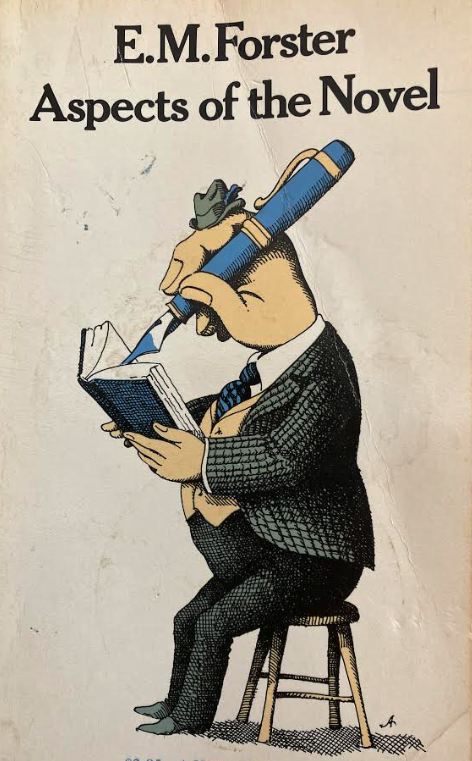
Yesterday, my blog delved into the mysteries of character building in a novel. I went, as I often do to E.M. Forster, who describes it so well in “Aspects of the Novel,” a book published in 1927. My beat-up copy was published in 1955. I think I found it at a used bookstore in the mid ’80s. I have a newer edition (it’s still in publication almost 100 years after its first printing) but it doesn’t have all my notes and underlines, so I somehow go back to this beat-up copy.
I really can’t open it even just to pull one little quote out without getting sucked in by his humor and his wisdom. So a few more words from Forster, these about the importance of story:
We are all like Scheherazade’s husband, in that we want to know what happens next. That is universal and that is why the backbone of a novel has to be a story. … Story can only have one merit: that of making the audience want to know what happens next. And conversely it can only have one fault: that of making the audience not want to know what happens next. These are the only two criticisms that can be made on the story … It is the lowest and simplest of literary organisms. Yet it is the highest factor common to all the very complicated organisms known as novels.
 Susan Palmer's Exquisite Now