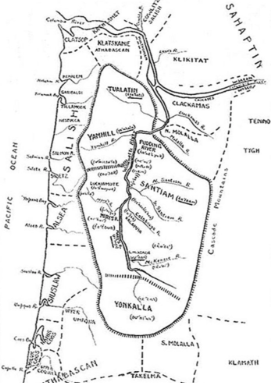
I want to spend some time this month considering the people who called the Willamette Valley home for thousands of years. Congress and then-president George Bush in 1990 set aside November to recognize the contributions of Native Americans, and I appreciate that effort as a reminder for me to learn more.
Here in Oregon the Kalapuya have been recognized for uniquely melding both coastal and plateau cultures, according to an overview by the Oregon Historical Society. The society’s articles are worth reading:
https://www.oregonencyclopedia.org/articles/kalapuya_treaty/
https://www.oregonhistoryproject.org/articles/historical-records/costume-of-a-callapuya-indian/
In a nutshell: Two deadly epidemics decimated the Kalapuya before white settlers arrived, reducing a population of around 20,000 to fewer than 500 (note that sources vary on these numbers). Treaties and broken promises, removal onto reservations, the loss of official tribal status all tell a familiar chilling tale. But the Kalapuya — along with dozens of other Pacific Northwest nations — persevered.
Among my favorite sources for learning about Oregon’s indigenous cultures is the website of Oregon State University professor David G. Lewis, whose Quartux Journal, has a wealth of information.
I particularly appreciate the brief history specifically focused on the Kalapuya.
Another good website for learning (from a full North American perspective) is Wisdom of the Elders, which preserves and shares cultural history, arts, language and ecological knowledge, seeking to enhance cultural sustainability, multimedia education, and cultural reconciliation.
https://wisdomoftheelders.org/
I loved seeing one of our local Kalapuya leaders, Esther Stutzman highlighted on that web site, where she tells the wonderful creation story of Le-lu, First Woman.
It’s yet another thing to be grateful for this month.
 Susan Palmer's Exquisite Now